Image Map
Showing posts with label math. Show all posts

Sunday, April 7, 2019

Addition and Subtraction (w/wo Regrouping)

Guided Math Lesson
When I taught 2nd grade before, I absolutely loathed teaching addition and subtraction with regrouping, and to be honest... I didn't do good job of it either! However, after teaching 3rd grade for seven years, I saw just how important that foundation was for students. So when I found I was going back to 2nd grade I knew I had to get it right this time.
Guided Math Kit
In October I had the honor of attending a Guided Math Conference (http://jessicaywinston.blogspot.com/2018/10/guided-math.html) and it changed my life!  Included in the registration was the Guided Math Grade 2 Unit 4 Kit. Fast forward to February and I'm finally starting to plan for my regrouping unit when I remembered the kit, I hadn't even opened it yet... and when I did, it was magical! (see video from website below)


It included...
  • Teacher Guide w/19 Lessons (I only needed to teach 1-15 to cover my state standards)
  • Warm Up Poster
  • Card Sets (write and wipe)
  • Storage Tote
I had everything I needed to thoroughly teach this concept!

The strategies included were...

Mental Math- Add the Tens

Mental Math- Add/Subtract the Tens (blocks)

Mental Math- Adding on a 120 Chart

Regrouping Blocks- Build It Trade It

Column Regrouping

Regrouping Blocks- Trade Down to Subtract

Number Line Addition and Subtraction


My students have done an amazing job and based on formative and summative assessments, they truly understand the concept. Below are links to the materials I used during this unit:
One purchase I will be making this summer is the Guided Math Grade 2 Unit 3 Kit. We spend an extensive amount of time covering basic addition and subtraction strategies at the beginning of the year and I can see how this kit would be very beneficial. 

Wednesday, November 7, 2018

Giant Place Value

Giant Place Value Manipulatives
Base 10 Pieces
 Many of you know that it's my first year back in 2nd grade after being in 3rd for the last seven years. In an effort to find fresh ideas I took to Pinterest when I found this! I couldn't wait to get started. I took some Astrobrights Cardstock (9.5x11) and trimmed the long edge to 10 inches. Then cut that in half so that I had two 4.25 inch pieces. Then cut that in half so that I had four 5 inch by 4.25 inch pieces. 
I ended up using 6 sheets of cardstock per color (pink, blue, green, yellow purple). That made ten Base 10 Rods and twenty Base 10 Units. 

I taped 5 together at a time. Then took two halves and taped them together to create the rod. I used a black marker to create the sections of the rod, added a smilie face and found some eyeballs in my clip art, but then found a sheet of them in this Frankenstein Craftivity I had purchased. I'm going to be honest, the eyeballs were a pain to cut out so you could just draw some or not put faces on them at all.  

I'm going to use them in my whole group lessons during my Guided Math Place Value Unit. The kids are going to work together to create numbers while the other kids identify them. I can also see using them when we start regrouping with addition and subtraction. 


Sunday, October 21, 2018

Guided Math

Me, Reagan Tunstall and my BFF Adrienne
On October 1st I had the opportunity to attend Reagan Tunstall's Guided Math Game Plan Conference with my best friend. It was simply amazing! I always considered myself a reading person, my strength, I felt, was teaching reading. Well after attending this conference I now feel like I'm a pretty good math teacher as well!

If you can't make it to one of her conferences she has a step by step guide on Teachers Pay Teachers on How To Launch Guided Math. I highly recommend downloading it and reading through it if you are at all interested in guided math. 

I wanted to share my plan on how I plan to implement guided math with my 2nd graders. 

Based on Reagan Tunstall's recommendations my 70 minute math block should be broken up like this:
Warm Up- 7 minutes
Whole Group- 18 minutes
Small Group- 38 minutes
Reflection- 7 minutes
I chose to break of my block like this:
Warm Up- 10 minutes
Spiral Review- 10 minutes
Whole Group Mini Lesson- 10 minutes
Small Group- Two 12 minute groups
Review Journal- 5 minutes
Reflection- 10 minutes
Here's what each component looks like in my classroom and links to the resources I'm using:

Warm Up- I decided to use Reagan Tunstall's Math Warm Ups for 2nd Grade. The students really enjoy them and it keeps them engaged. 

This was our Workout Wednesday Warm Up

Spiral Review- Back in May I blogged about implementing Daily Math Review in my 2nd grade classroom. I could have done away with it in lieu of the math warm ups but I have already created the booklets and my students love working in them daily. 

Whole Group Mini Lesson- I've been using lessons from The Moffatt Girls during my whole group lessons. Since it is a growing bundle every concept is available yet. I've been supplementing with resources from Amy Lemons and Reagan Tunstall. 

Journal Entry- After whole group and before math rotations begin, students have to complete a journal entry. I'm using handouts from The Moffatt Girls Math Made Fun bundle and shrinking them to 85% for students to glue and complete in their composition journals. Students can not begin their first rotation until their journal entry is completed. 

Rotations- I have 5 math groups that do 2 rotations a day, which means each group will visit each MATHS rotation twice a week. 

Math Facts- students practice their basic math facts at this rotation, it includes flash cards and centers on basic facts (the centers are from the Moffatt Girls Bundle)
Math Facts Activity
At Your Seat- students complete a math menu at this rotation, I use menus from Teacher's Clubhouse and Choose and Do Math Grids

Teacher Table- this is my small group rotation and where the bulk of my teaching happens, I use a variety of engaging activities to instruct students while they're in a small group with me, most of the lessons come from the Moffatt Girls Bundle
Odd/Even Small Group Activity
Hands On- students at this station work with math manipulatives and math mats, I also keep Flip and Solve Booklets at this station for students to work on as well 
Hands on Activity with Color Cubes and Math Mats
Stations- students at this station work with math puzzles and centers from the Moffatt Girls Bundle (as you can see I'm getting my money's worth with that bundle!)
Odd/Even Numbers Station
Review- After our two 12 minute rotations I briefly go over the journal entry while students check their work. 

Reflection- We do this to wrap up Math Workshop. I use the Reflection Cards from Reagan Tunstall, students share in partners or with their tables. These can be used in any subject area, not just math. 
Table Reflections
We've been going strong in guided math for about 3 weeks now and I love it! My students are really mastering the math concepts and it shows in their assessment scores. 

Friday, August 10, 2018

4 for Friday: Preassesssments


I've made great progress in my classroom, I've managed to get all of my boxes unpacked and put away. I won't be back until teachers report on the 27th. I'll spend the next 2 weeks vacationing with my husband and binge watching Netflix.

This week I want to focus on preassessing your students. It's important to gather data on your students at the beginning of the year so you can pinpoint exactly what they need before formal instruction and assessment takes place. 

Beginning of the Year Preassessments

Newmark Learning has created some wonderful assessments for every grade level in every subject. http://newmarklearning.com/free-resources.html 

1. Reading- I've been using the Comprehension Assessment for years now. I give the Pretest in September and the Posttest in January. I use the data from this comprehension assessment to form my flexible reading skill groups. My students will complete one passage a day for 7 days, I do not give it to them in one sitting.  Groups run from September to January and then January to May. I do guided reading from Monday-Thursday and on Friday I pull strategy and skill groups. Any student that scores 0-2 in a particular skill is placed in that group to be met with on a Fridays. I have 8-12 reading skill groups so I don't meet with all of them every Friday, it rotates. 
2. Math- They have a math assessment but I have never used it. When I taught 3rd grade I used the 2nd grade end of year benchmark assessment to assess what they had retained over the summer. Now that I'm moving down I will use a 1st grade cumulative assessment that targets our state standards (we are not a common core state). I use this data to form my guided math groups. 

3. Writing- It's important to get baseline writing data on your students so they can begin setting writing goals for themselves and so you can begin your list of writing mini lessons they'll need. I'll be using one Fiction and one Nonfiction prompt from Newmark Learning. 
4. Spelling- Now Newmark Learning does have a Phonics Assessment but I have not used it. My county administers the DSA: Developmental Spelling Assessment to each child. I use that data to form my word study groups.

I'd love to hear about how you preassess your students at the beginning of the year, leave a comment here or hop on over to our Facebook page and leave a comment.

Monday, May 28, 2018

2nd Grade Daily Math Review


It's Memorial Day, the unofficial start of summer! I still have 3 more weeks of school but I'm already getting ready for a new school year.
One strategy that I've found to be very effective is spiral review. This year in 3rd grade I did a Daily Math Review and Daily Reading Review. I truly feel these daily reviews made the difference in their standardized test achievement given this month. I knew I wanted to do something similar in 2nd grade. 
Next year I've decided to create a Daily Spiral Math Review booklet using this resource Math Spiral Review. Even though this product is aligned to the Common Core Curriculum and I teach in Virginia and we don't use those standards, I still intend to use it. I love it because it's 100% editable. I'm also going to buy the 1st grade version and modify those for weekly homework practice.
I also received the rest of the Picture Window Books I ordered for the 2nd grade curriculum, I'm super excited!  

Thursday, May 3, 2018

2nd Grade Homework

I've been thinking about what I want to do for homework next school year. This year, while teaching 3rd grade, they had a reading passage with 12 questions (Thunks Reviews) and 2 spiral math sheets (Math Madness). I sent it home on Mondays and it was due on Fridays.

For next year I created a Weekly Homework Menu. It will go home on Mondays and be due on Fridays. I wanted to be as flexible as possible which is why I listed "weekly suggested times" instead of "nightly" ones. I know how busy parents and students can be so I want them to be able to schedule their homework options.  

Reading- Reading for enjoyment is a given. I'm not into reading logs so I won't require them to track their reading. I also wanted to incorporate Find the Evidence passages so they can practice Text Dependent Questions. 

Math- Our county has a subscription to Dreambox Learning. It's an online math program that all elementary students have access to. I also wanted to incorporate math card games into our homework. While in 3rd I gave each family a ring of games and playing cards when they attended Math Night. I use the Dealing with Math Homework from Teacher's Clubhouse. I plan do the same next year during Back to School Night. My goal is to list the games that will help reinforce what's being learned in class. 

Study Guides- Like I shared last week, each family will also get a book of Study Guides that also have Study Methods included. 

Word Study- Since we do word study each day in class, it will not be apart of their weekly homework but I'll include options for parents who want their children to complete them.  

Sunday, November 12, 2017

Content Vocabulary Talks

Whew... the first nine weeks is over, 27 parent conferences have been had and report cards are finished! This was by far the most overwhelming busiest first quarter of school I've ever experienced! If this is any indication of the rest of the school year, my goal is to squeeze out a blog post monthly because who know's if I'll have time to do more than that!

I wanted to share an idea I've been doing with my third graders in math. I saw the idea while in a teammate's room. She had a Science Anchor with (animal) vocabulary words on it. At the top of the chart it said "If the answer is _____, what is the question?" So if the answer is "instinct," what is the question? Students had brainstormed possible questions and she had listed the final question next to the vocabulary word on the chart. 

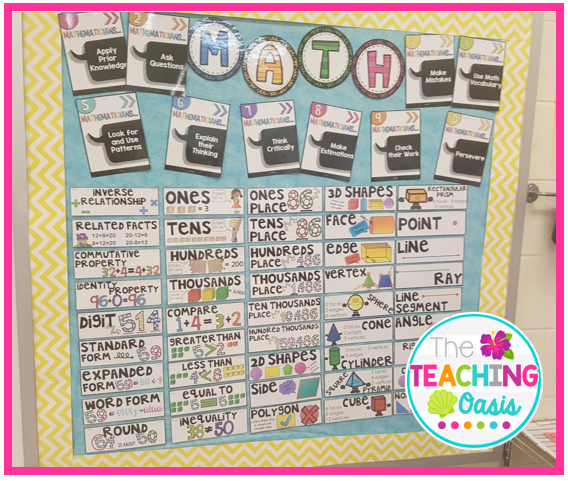
I immediately thought about the math vocabulary bulletin board in my classroom. I had been wanting to do something with the words after I remove them. I've decided to only keep them up for the quarter and then take them down for the next quarter's words. So, everyday I've chosen a "review" word from last quarter and posed this question...
  • The answer is angle, what is the question?
  • The answer is difference, what is the question?
I then give them a couple minutes to talk with their face partner or shoulder partner about possible questions. Then students share out their questions and I record them on the chart paper. I reread all the questions and students again talk with their face or shoulder partner about what they feel the "best" question is for the vocabulary word. We then decide the best one and I put a bubble around it. 
 This is a strategy that can be used in any subject. It really taps into the higher level thinking as they can't use the answer in their question. Some questions are more on the mark than others but with discussion those students are realizing how their thinking may have been too specific or not specific enough.

Can you see yourself using this strategy in your classroom?

The Math Vocabulary Cards were purchased from Amy Lemons and created any word cards that she didn't have that I needed. 

Sunday, October 8, 2017

Can't believe it's October!

I can't believe it's already October! Tomorrow I host my 2nd annual Parent Math Information Night and next week I start Parent Teacher Conferences. It's going to be a busy month. 
Here are my Parent Math Night Goodies
I created a PowerPoint Presentation for the information session and I also put together an informational packet for parents. I also included an SOL Math Review Sheet as well as Card Games activities for students to play at home. 
My students have been hard at work. I took a few pictures to showcase some of the things we've been doing. 
Students Wrote about what makes them "CRANKY"
We read Crankenstein and students wrote about what makes them cranky. We then created out own "Crankenstein" from Krista Wallden's Frankenstein Craft Printable.
Students Wrote about the Pumpkin Life Cycle
Last week we read several books about the Pumpkin Life Cycle and students wrote a short report. Then then used Amy Lemon's Pumpkin Craftivity to complete their covers. 
Reading Groups
My teammate snuck in while I was doing reading groups last week and tweeted this picture of my students working on writing the main idea and supporting details of our guided reading book. 
Guided Reading Rotation PowerPoint
Speaking of guided reading... I absolutely love the PowerPoint Slide I created for rotations. I use the acronym READS and we go through 2 rotations a day. Then for the 3rd rotation I pull a flexible reading skills group or conduct writing conferences while students work on word study. I love the fact that's this is projected the entire time and that students can track how much time they have left to complete their task. 

Well that's all for today, I've been at a vendor event helping my friend at her LuLaRoe booth and I'm utterly exhausted, I'll be sleep soon!

Friday, February 17, 2017

Photo Friday 2*17*17


I just finished up a 3 week unit on Geometry. In Virginia we focus on solid shapes, lines and concurrency. While my students don't need to know the vocabulary "acute" and "obtuse" they do need to know what's smaller and larger than a right angle.  
One of my favorite activities to do with them is Angle Aerobics. It's an activity from an AIMS book called Shapes, Solids and More. The activity only cost $2 if you're looking to purchase it but you don't necessarily need it. Students use their bodies to show acute, obtuse and right angles. I have them practice standing up and also sitting down.

What resources do you use to teach Geometry?