Image Map
Showing posts with label stem. Show all posts

Monday, July 5, 2021

Ingenuity Lab


I'm two weeks into my summer vacation and I've just about completed my first summer project. Last week, I sat in on interviews for a 7th teammate and my principal asked candidates a very important question. "What are some ways you will accommodate for learning and emotional gaps that students may show?" You see, this particular group of rising 2nd graders had their Kindergarten year cut short by the pandemic and then could have possibly spent their entire first grade year in the virtual learning setting. I'm already  looking to be either  trained in Youth Mental First Aid or Trauma Informed Care but it's going to take much more than that to meet these students where they are. 

One idea I want to implement is an Ingenuity Lab (ingenuity is one of our school system's core values). I decided I wanted to start our days off with creativity. So instead of traditional morning work, students will come in and grab their bin for the week and complete that day's challenge. This is very similar to morning tubs or morning missions as I've also seen them called. 
I made 24 bins. 2 of each type of material. I didn't have to purchase much, I already had most of the supplies I wanted to use on hand.  In each bin I included a ring of 7 task cards. 4 picture cards and 3 three-dimensional shape cards. I could have used more consumable materials like index cards, tape, craft sticks, pipe cleaners, etc. however I wanted something low maintenance considering the students will use these each day. 

Here's a list of the materials I used:

If you'd like to implement this in your own classroom, the materials are located here: Ingenuity Lab. 


Saturday, March 12, 2016

Spring Break Learning Opportunities

In two short weeks we'll be on Spring Break. I wanted to provide my students with optional learning opportunities but I didn't want to overwhelm them. I put together a couple of activities that I'll send home with them.
 
1. I purchased Amy Lemon's Student Reading Challenge from Teachers Pay Teachers. This reading challenge is a bucket list that students can complete during any of the school breaks.
 
2. I try to incorporate STEM activities into my classroom and ran across these "STEAM Break" activities on Teachers Pay Teachers... for FREE. They are from Digital Divide and Conquer, I love the PBL Units from this shop and was excited to see some STEM activities students could complete at home.
 
3. The last activity I included was a sheet with multiplication and division practice I found in my files.
 
All of these activities are optional, students do not have to complete them. I'll give out stickers for Super Improver Cards and probably put together some other prizes for students who choose to participate.  Do you send home activities for students to do during school vacations?
  

Friday, May 8, 2015

Day 5: Teacher Appreciation Week


Since it is the last day of Teacher Appreciation Week I gave my friends a gift that said "Don't be blue, know that you are appreciated for all you do!" I included all blue stuff much like the yellow stuff yesterday for the sunshine bags. 
https://drive.google.com/file/d/0B3EdWT-xPuMIaWpETzllUHpaM3c/view?usp=sharing
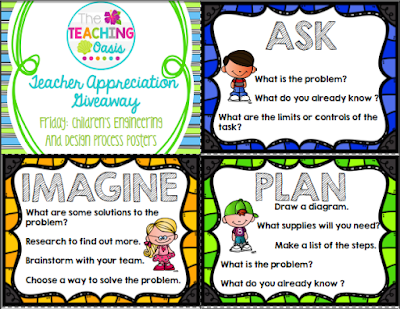
Design Process Posters [Click Picture to Download]
Today's resource is a set of Children's Engineering and Design Process posters.
 
Today I'm giving away a $10 Target eGift Card. You have until midnight to enter the Rafflecopter below.
a Rafflecopter giveaway

Thursday, June 20, 2013

STEM Conference 2013

Last year I attended a two day conference at our regional Math Science Innovation Center for grades K-3. Afterwards I blogged about the keynote speakers, the writers of Picture Perfect Science Books. If you haven't read that post, hop on over and do that now, Picture Perfect Science. I learned a lot from that conference and was able to used what I learned to create Children's Engineering Design Briefs for my Social Studies content and got some great ideas on picture books for Science content. I had the opportunity to attend another conference this year geared toward 3-5 and loved every minute of it.

The author's from Picture Perfect Science came back and showcased some additional lessons. We even received a free book of our choice. Last year I purchased Teaching Science through Trade books (my favorite of all 4) and More Picture Perfect Science. My colleague, the one who's actually taught Science to my students the last two years, purchased Picture Perfect Science. Since I had access to the previous three books I chose the new book...Even More Picture Perfect Science. Since my colleague is moving back to second grade I've decided to take on the science instruction of my own students. So I'm looking forward to integrating my curriculum even further using lessons from all four of these books.

I hit math really hard this year... it was my professional goal. I read the book Number Talks and implemented monthly number sense quick checks (blogged about all that here) and my students number sense increased 100%! But they still struggled with Fractions so I was excited to hear about this book, Beyond Pizza and Pies: Supporting Fraction Sense. Guess this will be my summer read. I was looking for a professional book and I think I've found one. I'll keep you posted.  

Last but not least I learned about a company that creates a cross-curricular way to teach Children's Engineering (to those of you who don't know, I teach in a Children's Engineering and Design Technology School, I'm required to do engineering activities). It's called Engineering is Elementary and each kit ($50) comes with a multicultural storybook and teachers guide. I actually won the Balances and Forces kit at the workshop! I think I'm going to donate that to the 5th grade team, I could use it for sure, but it really ties in to their Science Standards. I looked at the 20 units and decided to purchase one for each strand (Physical, Life, Earth and Space)/one for each quarter. I settled on Ecosystems, Water, Simple Machines and then Solids and Liquids as a fun 4th quarter review. Below is the lesson plan structure:

Preparatory Lessons (20-30 min): The preparatory lesson is designed to prompt students to think about engineering, technology, and the engineering design process. If teachers have done little with engineering and technology in their classrooms, we suggest that they start an EiE unit with this short introductory activity.

Lesson 1, Engineering Story (60-90 min): The first lesson sets the context for the unit through an illustrated storybook. A series of questions to promote student reflection before, during, and after the story encourage students to reflect upon the story and its engineering components and reinforce literacy skills.

Lesson 2, A Broader View of an Engineering Field (30-40 min): The second lesson focuses on helping students develop a broader perspective on the unit's engineering field of focus. Through hands-on activities, students learn more about the types of work done by engineers in these fields, and the kinds of technology they produce.

Lesson 3, Scientific Data to Inform Engineering Design (40-50 min):The third lesson is designed to help students understand the linkages between science, mathematics, and engineering. In this lesson, children collect and analyze scientific data that they can refer to in Lesson 4 to inform their designs.

Lesson 4, Engineering Design Challenge (1-3 sessions of 40 min):The unit culminates with an engineering design challenge. Following the steps of the engineering design process, students design, create, and improve solutions to an engineering problem. Design challenges are used as the final project because they allow students with varying academic abilities to succeed; they are easily scaled to meet the needs of all students.


So I have fallen in love with these units and the fact that they explore all types of engineering (environmental, civil, biomedical, ocean, agricultural) and that each story is set in a different country. I'll probably do the majority of the lessons during my language arts block, as there is more flexibility there and a larger block of time. I may do the design challenges during our actual 45 minute Science block.

Any thoughts? Comments are always welcome!